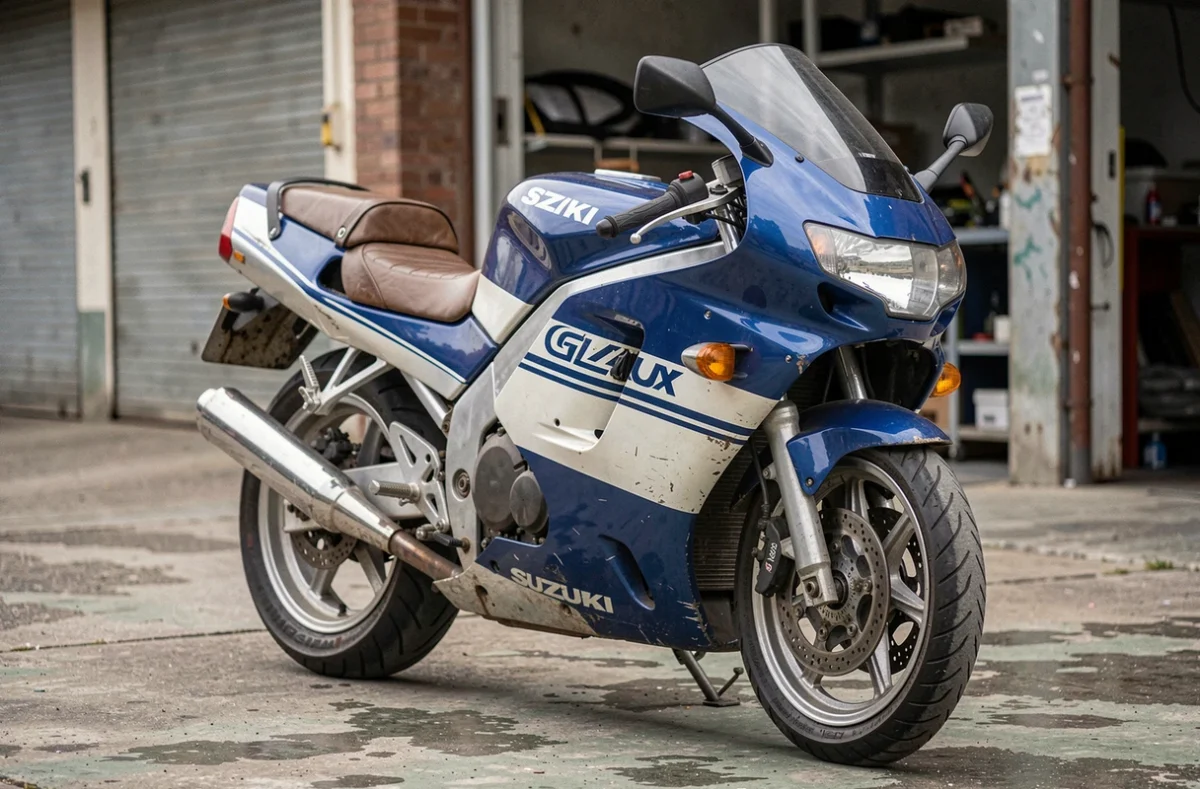
The Suzuki GSX-R 1100 is no longer just a sports bike from the 1980s-1990s. It has now become one of the motorcycles that attract collectors as much as enthusiasts of Japanese big bikes. Understanding how its value evolves in 2026 requires looking beyond an average price, because this model is anything but homogeneous.
Why the value of the GSX-R 1100 cannot be summed up in a single figure
Have you ever compared two GSX-R 1100 listings and found a price difference that ranges from simple to triple? That’s normal. A GSX-R 1100 listed at 4,590 euros in France can coexist on the market with a 1987 version offered at 11,500 euros in the Netherlands. Between the two, there are first-generation examples around 6,390 euros on Leboncoin.
These discrepancies are not random. They reflect concrete differences: generation (the early oil-cooled models, the water-cooled W versions), the condition of the bike, mileage, presence of original parts, maintenance history. An original complete GSX-R 1100 is worth much more than a modified version, even if both run perfectly.
Buyers who follow the market price of the GSXR 1100 notice this: the price dispersion makes any average misleading. A rare, documented example that conforms to its factory configuration trades in a significantly higher range than common versions.
Collection registration and ZFE: two administrative levers that impact value
The first GSX-R 1100s, produced from 1986, are now over 30 years old. They can therefore qualify for collection registration, an optional status that changes the game for circulation and valuation.
What collection registration concretely brings
The collection status facilitates circulation in certain low-emission zones (ZFE). In France, ZFE restrictions are gradually tightening, and an old motorcycle without collection registration risks being banned from circulation in large urban areas.
By obtaining this status, the owner secures the use of their motorcycle in the city. It is a concrete selling point that enhances the value of eligible examples.
Conditions to be met
- The motorcycle must be over 30 years old and its production must have ceased
- It must not have been substantially modified from its original configuration
- The application remains optional, but it becomes strategic for owners in urban areas
For a GSX-R 1100 from 1986 to 1992, these criteria are generally met, provided the model has not undergone heavy transformation (frame change, engine from another generation). The collection status acts as a historical compliance certificate, which reassures buyers.
Classic motorcycle insurance: a reduced cost that supports demand
Why does this point matter in the evolution of value? Because the cost of ownership directly influences the number of potential buyers. A motorcycle that is expensive to insure attracts fewer people.
Classic motorcycle insurance operates on a different model than standard contracts. They offer lower rates in exchange for specific usage conditions:
- A limited annual mileage (often a few thousand kilometers)
- Leisure use, no daily commuting
Lower insurance premiums make ownership less costly, which maintains the model’s attractiveness among enthusiasts of classic Japanese sportbikes. The more interested buyers there are, the more stable the value remains.
GSX-R 1100 in relation to the new motorcycle market in 2026: a unique positioning
The new motorcycle market in France is experiencing strong dynamics in 2026. Registrations of large-displacement bikes are increasing, and Suzuki itself is making a strong comeback with commercial initiatives on the new range.
What does this have to do with the used GSX-R 1100? New and collectible bikes do not attract the same buyers. The GSX-R 1100 enthusiast is not looking for a modern motorcycle. They are looking for an iconic model, a machine that embodies a time in motorcycle sports.
The increase in new motorcycle sales does not cannibalize the collectible market. It can even indirectly feed it: a motorcyclist who buys a new sportbike sometimes discovers the Suzuki universe and becomes interested in historical models.
The criteria that affect the price of a GSX-R 1100 in 2026
Before buying or selling, it is essential to understand what drives a price up or down. Here are the key parameters.
The generation remains the primary sorting criterion. The oil-cooled versions (1986-1992) and the W versions (from 1993) do not play in the same price category. The former, being rarer, attract more collectors.
The condition of originality weighs heavily. A repainted bike, non-compliant parts, or an aftermarket exhaust lowers the perceived value. Conversely, a well-maintained service book and period invoices are a real plus.
The country of the listing also plays a role. Dutch or German examples may show higher prices than comparable French listings due to different local demand and sometimes stricter preservation standards.
A well-documented example with collection registration represents the most valued profile in the current market. Informed buyers know that a compliant GSX-R 1100, insurable at a collection rate and allowed in ZFE, ticks all the boxes for a sustainable motorcycle investment.