
What indicators allow us to distinguish a structuring high-tech trend from a mere announcement effect? Between the energy consumption of data centers, the migration to post-quantum cryptography, and new embedded AI architectures, the signals for 2025-2026 outline measurable priorities. The latest high-tech trends are not just about showcase products: they are reconfiguring infrastructures, budgets, and corporate decision-making.
Electricity Consumption of AI and Location of Data Centers
One of the least addressed angles in technological assessments concerns the direct link between energy availability and the location of digital infrastructures. Energy efficiency per AI request has significantly improved in recent years. Despite this, the total consumption of data centers dedicated to artificial intelligence has sharply increased in 2025.
The International Energy Agency predicts a nearly doubling of global electricity demand from data centers by 2030. This figure puts into perspective discussions about algorithmic optimization: unit gains are being absorbed by the growth in the volume of requests and model training.
According to MarketScale, new data centers are now being planned around the capacity of electrical substations rather than around network connectivity or user proximity. For those who wish to consult high-tech articles on Ask Nerd, this shift illustrates how much innovation today depends on concrete energy trade-offs.
| Location Criteria | Historical Priority | Priority 2025-2026 |
|---|---|---|
| Network Connectivity (fiber) | First | Secondary |
| User Proximity | Important | Variable depending on the use case |
| Local Electrical Capacity | Secondary | First |
| Access to Renewable Energies | Optional | Differentiating Factor |
This table summarizes a paradigm shift: reliable access to electricity now determines the location of AI data centers, not fiber optics.

Post-Quantum Cryptography: From the Laboratory to IT Procurement
Post-quantum cryptography is no longer solely a matter of academic research. Compliance requirements are being announced for new sensitive systems in the United States starting in 2027. This deadline transforms post-quantum migration into a procurement, architecture, and management issue for existing assets.
Specifically, companies deploying cybersecurity systems today must integrate post-quantum compatibility into their tenders. The cost of retro-migration will be significantly higher than that of native integration from the design stage.
- Inventory of Cryptographic Assets: identify the certificates, protocols, and keys that will need to be replaced or updated before regulatory deadlines
- Evaluation of cloud and SaaS providers based on their post-quantum roadmap, a criterion still absent from most evaluation grids in 2024
- Compatibility testing of existing systems with standardized post-quantum algorithms, to anticipate performance conflicts
Preventive cybersecurity is no longer limited to behavioral detection. It now includes a structural aspect related to cryptographic resistance against upcoming quantum computing capabilities.
Agentic AI and Edge Computing: Two Converging Technological Trends
Behind the term agentic AI lies a concrete evolution: artificial intelligence systems capable of making chained decisions without human intervention at each step.
This decision-making autonomy takes on a different dimension when executed at the edge of the network (edge computing). Local data processing reduces latency and dependence on remote servers, opening applications in industrial robotics, health-connected objects, or autonomous vehicles.
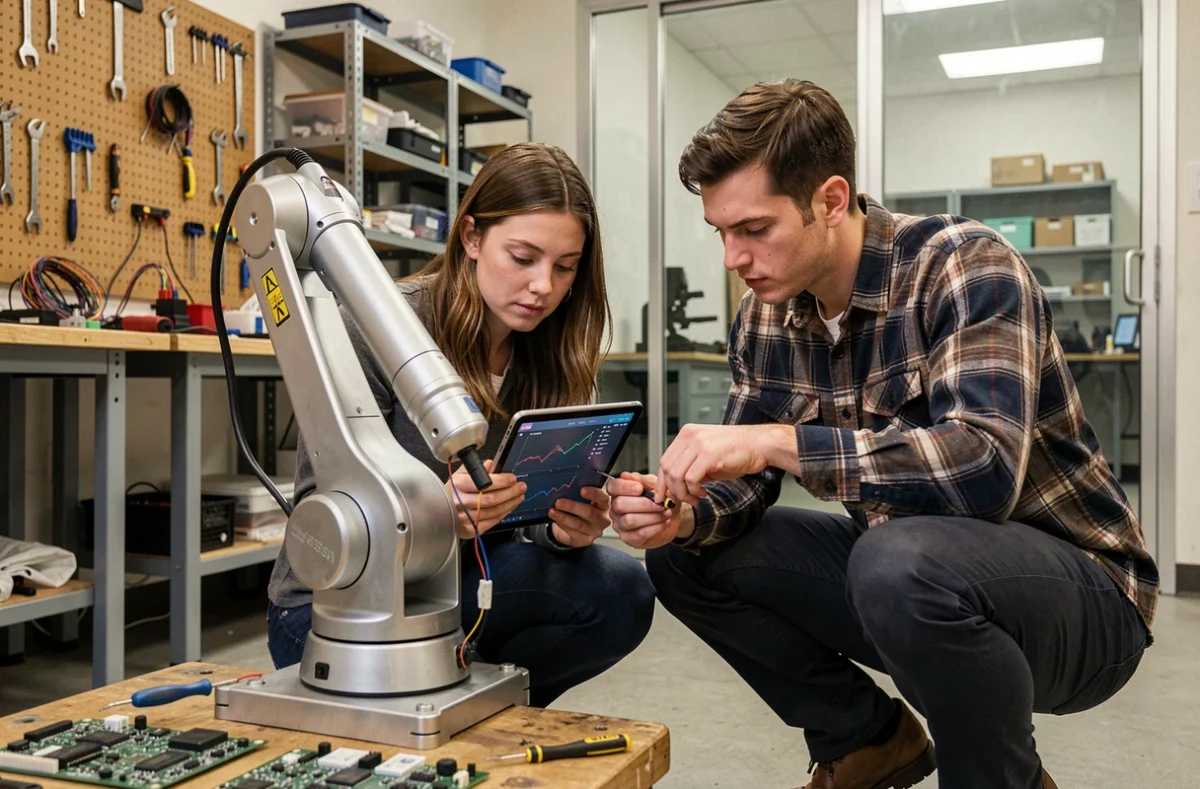
However, agentic AI raises governance questions that companies have yet to resolve. When an AI agent chains several decisions autonomously, the traceability of intermediate choices becomes a regulatory compliance issue, particularly within the framework of the European AI Act, whose first transparency obligations are coming into effect.
AI Regulation: Timeline and Geographical Fragmentation
The global regulatory landscape is fragmenting. The European Union is moving forward with the AI Act, while other jurisdictions adopt sectoral or voluntary approaches. This fragmentation creates a compliance cost for companies operating in multiple markets.
Technology organizations must arbitrate between compliance with the strictest standard (often European) applied globally, or a differentiated approach by geographical area. The first choice simplifies the architecture, while the second reduces constraints in less regulated markets.
AI-Powered Robots and New Digital Interfaces
AI-powered robotics is advancing through training in simulated environments before any interaction with the real world. This approach reduces the time and cost of robot training but raises the question of transferability: behavior learned in simulation does not always reproduce results in real conditions. The gap between simulated performance and field performance remains a key indicator for assessing the maturity of a robotic system.
- Health-connected objects (mirrors analyzing physiological parameters, wearable sensors) generate data that feed increasingly accurate AI models
- Natural interfaces (eye tracking, gesture recognition) are gradually replacing traditional peripherals in industrial and medical environments
- Augmented reality glasses for professional use stand out from consumer versions due to their sector specialization and robustness
The high-tech trends of 2025-2026 share a common trait: they shift constraints. The constraint is no longer network bandwidth but access to energy. The cryptographic risk is no longer theoretical but embedded in regulatory timelines. AI no longer lacks computing power; it lacks governance frameworks suited to its increasing autonomy. It is these shifts in constraints, more than product announcements, that will determine technological investments in the coming years.